
Pikesville Previous Residents by Record Era
Different record eras carry a Pikesville address backward in different ways. Land records establish transfers and legal descriptions. Directories supply household clues for an earlier year. Census schedules add a household snapshot once public. Sanborn maps and permits track changes to the building or parcel. A prior owner's sale alone never proves where that owner lived next.
| Source | Years It Covers | Where Held | What It Shows |
|---|---|---|---|
| Baltimore County land records | Modern material to earliest surviving county records; index timing varies | MDLandRec, Archives, Circuit Clerk | Transfer parties, legal descriptions, instruments, and prior references |
| Grantor/grantee indexes | 1655–1851 series located, plus later paper/electronic indices | MSA Guide, search room, MDLandRec indices | Name and book/page paths |
| Criss-cross and city directories | 1928 criss-cross; broader Baltimore directories 1800–1940 and scattered later runs | MSA, BCPL, libraries, Archive.org | Address-arranged and alphabetical household clues |
| Federal census | Public through 1950 under the 72-year rule | NARA and library databases | Household composition and relationships |
| Sanborn and permits | Sanborn metropolitan Pikesville series 1929 corrected to 1959; current permit files vary | MSA, map resources, county PAI | Structure, use, address, and property-work context |
Start with SDAT and the current deed. That works when the street address is already known. Once the electronic name route stops, shift to historical indexes and book/page jumps for the title trail. Households need a different trail. Use the address sections of directories, then match the directory year to the nearest census; the Pikesville city directory collection describes those volumes in detail, and this approach applies them to a single property.
Pikesville Previous Residents in MDLandRec
MDLandRec hosts Baltimore County's deed index and digitized records reaching from modern filings toward the earliest surviving series. The Archives Baltimore County land-series inventory documents the material that survives from 1659 to 1851. Where the online name index starts varies. The book and index category set the entry point. Surnames trip up every search. The documented Begins With, Ends With, Contains, Fuzzy, and Soundex controls help with difficult spellings.
Access requires the current account. Create it, then select Baltimore County. Search with the parcel's book/page or the party names. The Version 5 system offers active, historical, and retired index categories, plus a book/page jump for records predating the electronic index. Record the book, page, recording date, legal description, grantor, grantee, and any cited prior instrument before moving to an earlier conveyance; that written chain keeps prior residents research tied to one parcel instead of a merely similar name.
Pikesville Addresses in Sanborn Maps
Fire-insurance maps answer a different question than deeds. The Maryland State Archives metropolitan Sanborn series covers Pikesville in a 1929 volume corrected to 1959, and the Baltimore Sanborn Volume Finder adds related atlas coverage spanning 1890 to 1953. The sheets show footprints, materials, and uses. That detail tells you whether an old address held a house, a business, or an entirely different building. It does not list previous residents.
The Maryland Archives Pikesville Sanborn series remains the visual source for the address history itself.
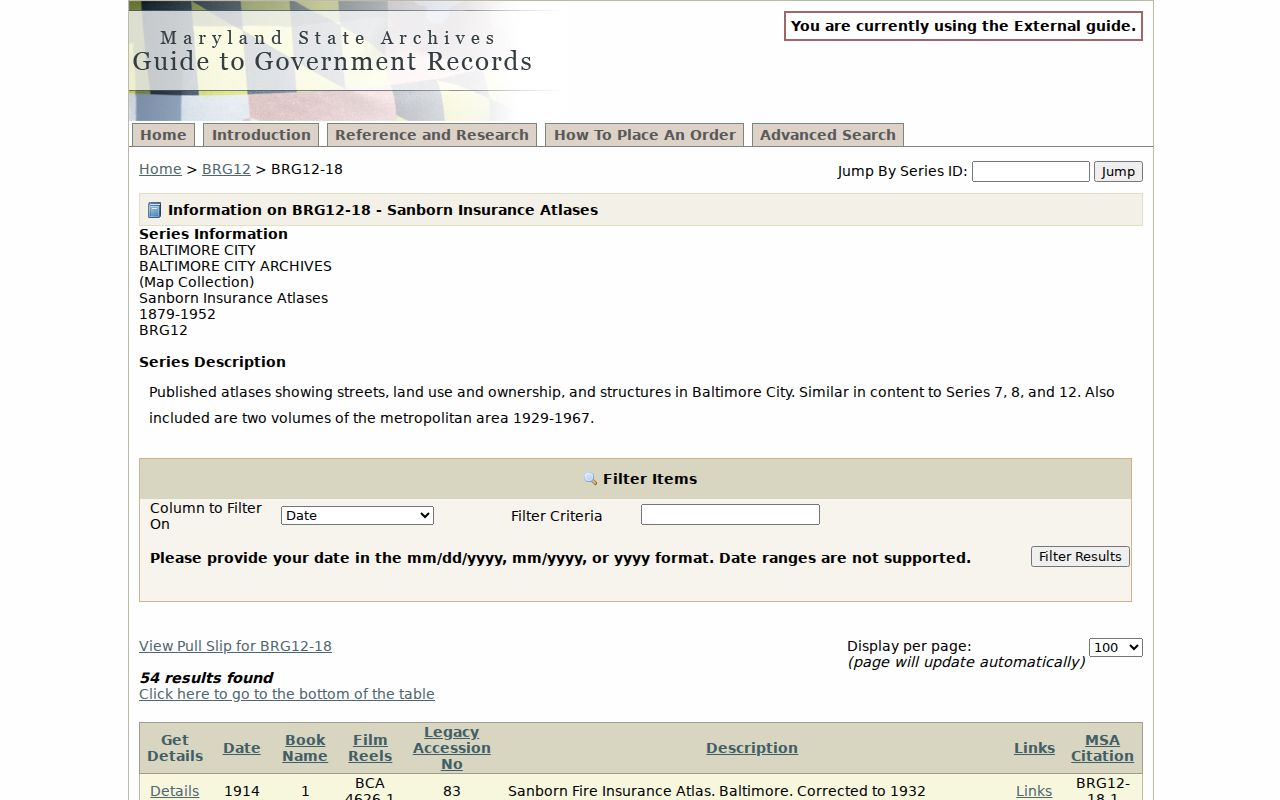
Use the map to test the building's historical context. Then return to deeds, directories, census records, or probate files for the names and household details behind the address.
Pikesville Previous Residents Beyond Web Search
A failed web search is not the end. Maryland State Archives catalogs Baltimore County land, court, naturalization, marriage, tax, and directory series. Some material needs microfilm or an in-person visit. Its fee schedule states the indexed-search, certified, digital, and onsite-copy options. Current records have their own channel. The Circuit Court Clerk's Towson counter serves it. BCPL's Pikesville Branch helps as well. It offers in-branch research tools, printed resources, and librarian assistance. The Historical Society of Baltimore County keeps maps, cemetery inscriptions, surname files, photographs, and selected directories.
Newspapers and estate files work differently. Obituaries, cemetery records, estate files, and newspapers can confirm a family relationship, death, executor, or former locality rather than an address. Confirm before adding anyone. Check the estate number, directory year, deed, or another primary source before placing a person in a property's past household trail.
Keep notes on failed searches too. Record the name form tried, the date span, the index category, and the book/page references already checked. That log sharpens any follow-up. An Archives or clerk request becomes more precise, and the same limited online index never gets searched twice.
Tracing Pikesville Previous Owners Through Deeds
The SDAT parcel card anchors the title trail. Reach it by address, PAN, or map reference. The Maryland Courts land-record guide explains the Circuit Court Clerk's role and the common instruments involved. Copy the current owner, legal description, sale date, and any book/page reference. Open that instrument in MDLandRec. The seller or grantor there points backward. Search that name as a grantee in an earlier date range to find the preceding purchase. Repeat the loop only when the legal description, tract, lot, subdivision, or book/page proves it is the same property.
- Find the modern parcel through SDAT and record its PAN, legal description, book/page, and transfer details.
- Open the current conveyance by book/page or party search in MDLandRec.
- Note the grantor, then search that name as a grantee during the earlier period.
- Continue backward using legal descriptions and cited prior instruments, not a street address alone.
- Use historical indexes, Archives microfilm, book/page jumps, or the Towson clerk counter when the online index ends.
- Grantor and grantee
- The party transferring an interest and the party receiving it in a recorded instrument.
- Chain of title
- The chronological sequence of recorded transfers for the same parcel.
- Legal description
- The deed wording that identifies land by lot, tract, subdivision, metes and bounds, or another land reference.
Pikesville Previous Residents and Deed Index Clues
The MDLandRec grantor-grantee search guide walks through the book-and-page route for tracing a Pikesville address back through past owners.
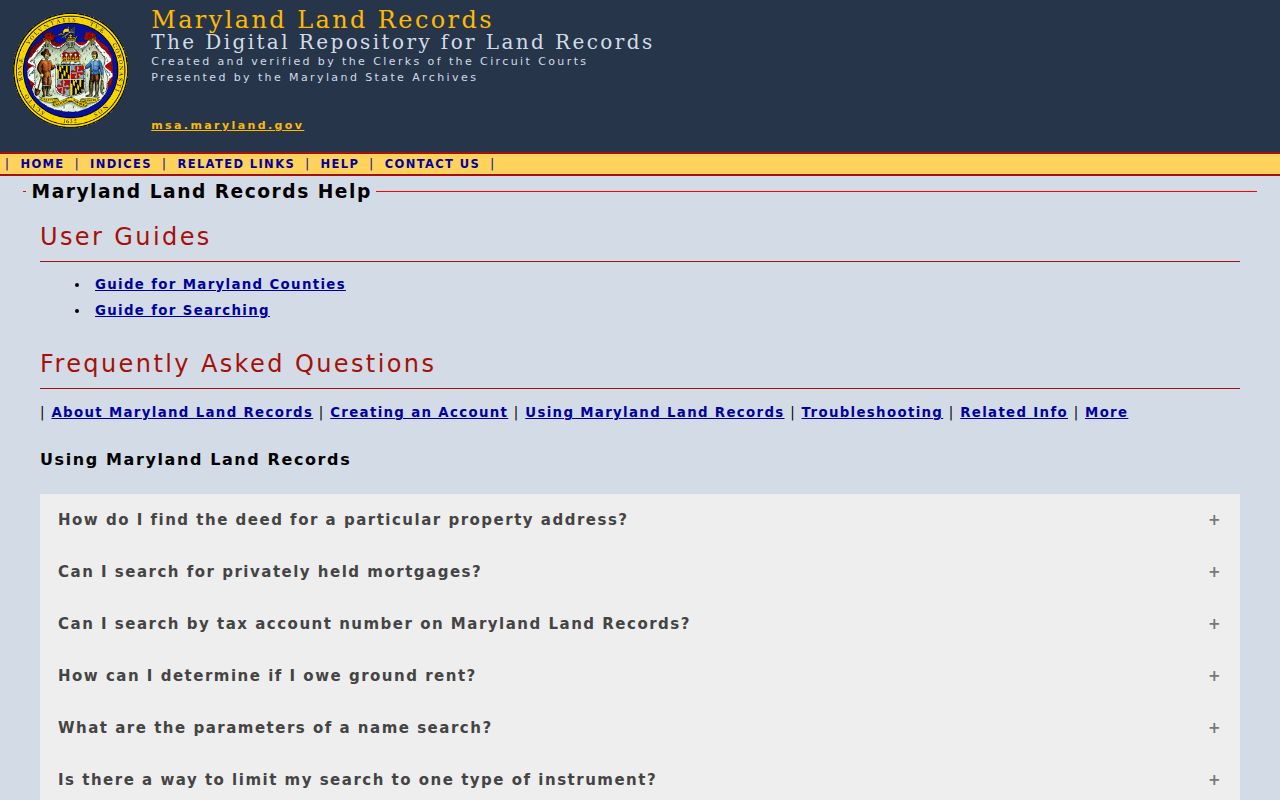
A free image helps you trace a recorded transaction. A certified copy is a separate order, and a viewable image is never permission to reproduce sensitive information.
Pikesville Previous Residents and Changing Place Names
Older Pikesville records rarely read like a modern address database. Baltimore County land records reach back to colonial tract descriptions. The community itself grew along the Reisterstown Road corridor near the Baltimore City line. A historic deed may cite a liber and folio. It may name a tract, a lot, a block, or a subdivision instead of a current house number. A historical directory can print Baltimore, Baltimore County, Pikesville, Greenspring, Reisterstown Road, or another postal locality. The very same area can carry all of those labels.
Keep an address worksheet as the trail moves backward. Log the current street address. Add the PAN, the legal description, book and page, older street wording, map references, the date, and the locality each source prints. Then compare the description against the parcel and a period map. A resemblance alone is not a match. No official Pikesville-specific street-renumbering year is published. Read the old wording from the record itself rather than assuming one conversion rule.
The Maryland State Archives separates active, historical, and retired land indexes for a reason. The system evolved from bound books and paper indexes to microfilm, scanning, and the modern MDLandRec platform. A name can therefore be absent from one search interface yet appear in a scanned index or book. The book and page route often bridges a modern property card to an older Pikesville address history.
Name variants matter more as records age. A directory may use initials. It may add a spouse notation, an abbreviated given name, a former surname, or an occupational business name. MDLandRec lets you narrow a deed-party result with first-name, middle-name, suffix, and last-name controls. Its Fuzzy and Soundex options help with older spellings. Confirm each candidate through the legal description and the recording sequence before adding a name to the previous-residents timeline.
Offline channels still count. The Baltimore County Circuit Court Clerk accepts documented copy requests. The Maryland State Archives search room or order service handles older indexed material. Pikesville Branch visitors can use public computers, copying, and librarian appointments. The Historical Society's map, surname, cemetery, and clipping files can add context for a hard-to-place family. A complete address history usually needs both online and in-person work.
Pikesville Previous Residents in Household Sources
Ownership tells only part of the story. A criss-cross directory arranged by address can place a household, business, or subscriber at a number. The alphabetical section adds occupation and a spouse notation. Record the spelling exactly, then test the same address in nearby directory years. Missing volumes and missing entries are common. A no-hit year does not prove the address was empty. Pair the directory year with the closest public federal census. That weighs the address clue against household composition.
The census follows a 72-year release rule, so 1950 is the most recent public enumeration. Pikesville search terms may call for Baltimore, Baltimore County, Greenspring, Reisterstown Road, or another nearby locality. They may also call for an older street label. Obituaries, funeral-home archives, Historical Society cemetery inscriptions, and estate files can close a family trail. A burial or obituary clue, though, does not prove the last residence.
Lawful use. Pikesville previous-resident research is suited to house history, family history, heir research, and personal curiosity. Maryland Criminal Law §§3-802 and 3-803 prohibit stalking and harassment; never use an old address trail to pursue or harm a living person.